

For twenty years,
“get found online” meant one thing: rank on Google.
Optimize the site, build the backlinks, claim the Google Business Profile, wait for the traffic. It worked, for a while.
Why? Because search engines used to be the only front door.
You typed a query, you got ten blue links, you scanned past the ‘sponsored ads’ and often clicked through, and decided for yourself who looked most credible.
AI tools leap over that process.
ChatGPT, Gemini, and the AI Overviews now sitting on top of regular Google results don’t hand the user ten options; they hand the user one answer. This is synthesized from whatever sources the model trusts enough to summarize.
The user often doesn’t click through to a website at all.
They just act on what the AI told them.
What should business owners and managers do?
You must own the narrative more than just keywords. Don’t leave it up to chance, curate the AI results through Ai Search Optimization (AiSO).
Want to see it in action? Here’s my personal result that’s been intentionally curated:
Now that I’ve shown you mine, show me yours:
Open ChatGPT, Gemini, or Perplexity and prompt it a question you’d expect your own customers or clients to ask:
1) “Who is [add your name]?”
2) “What is [add your business name]?” or, ask anything relevant to your industry.
Read what comes back. Are you surprised? Is there anything you’d change?
If your business isn’t in that answer, or worse yet, it’s not accurate your visibility is currently low and the narrative is inconsistent.
“If your business isn’t in that answer, or worse yet, it’s not accurate your visibility is currently low and the narrative is inconsistent. “
That’s the shift I want to talk about, not as a scare tactic, but as the actual practical thing I’m now building into every strategy I run for clients on both sides of the Atlantic (and the Gulf).
The Quiet Shift From “SEO” to “AiSO”
Ranking well on Google used to be enough because Google was the referee. Now there’s a second referee in the room one that reads differently, indexes differently, and rewards a different kind of content than the pages stuffed with keywords that used to win.
A few things I’m seeing consistently with the businesses I work with:
AI models favor clear, structured, well-sourced content over content built to game a keyword. If your site reads like it was written for a search algorithm instead of a person, that tends to show up as vague or absent in an AI-generated answer.
Being “known” matters more than being “optimized.” These models draw on more than just your website: your LinkedIn presence, press mentions, directory listings, and how consistently your business is described across the web all feed into whether an AI trusts you enough to recommend.
Nobody has fully cracked this yet, which is actually the opportunity.
The businesses moving early aren’t competing against hundreds of well-optimized rivals the way they would on Google: they’re often the first business in their category to show up cleanly in an AI answer at all.
I’ll come back to what I’m doing about this with clients a little further down.
But first, I want to walk through what this actually looks like in practice, because “AI search optimization” is still vague enough that most business owners nod along without picturing anything concrete.
What This Actually Looks Like
Picture a small, well ran professional services firm:
One with a strong reputation built entirely on referrals and word of mouth. Good reviews. A functional but dated website. A Google Business Profile that hasn’t been touched since it was created. LinkedIn used occasionally, mostly for hiring.
By traditional SEO standards, this business isn’t in bad shape. It’s not losing search rankings. It’s not getting flagged for anything broken. If you ran a standard SEO audit, you’d find a handful of quick fixes and call it a day.
But ask an AI assistant “who does [this kind of work] in [this city],” and the business doesn’t come up.
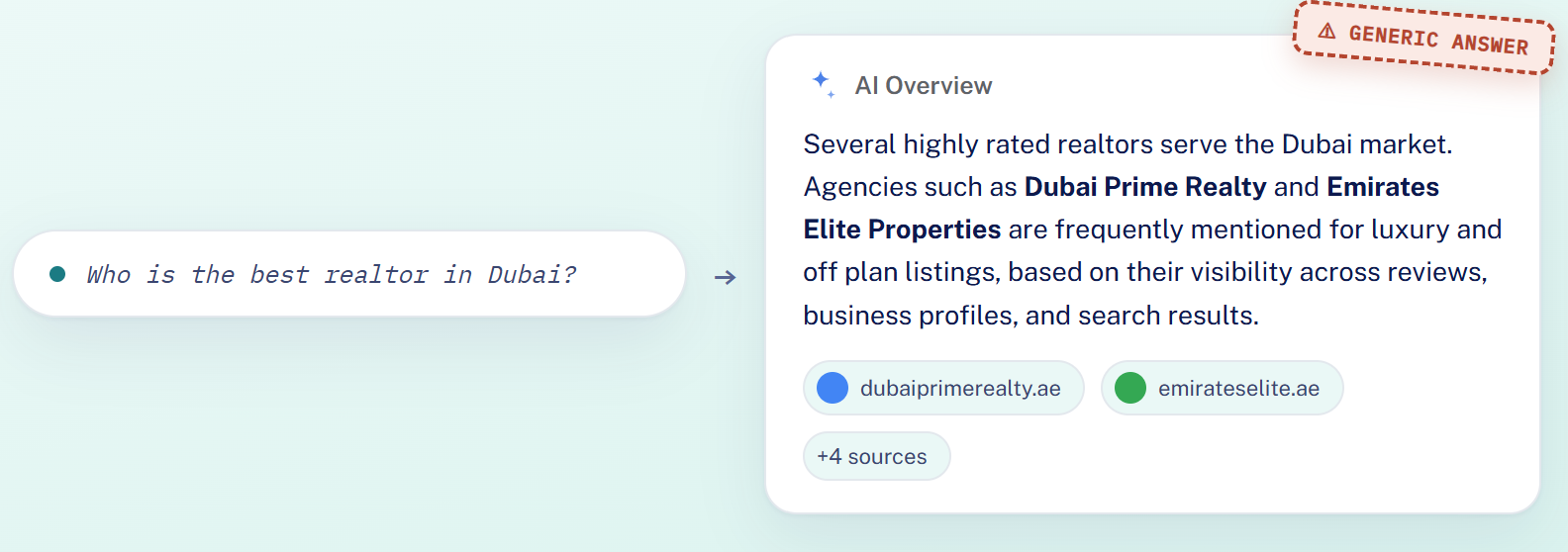
Not because it’s doing anything wrong, because there’s almost nothing for the model to point to. No clearly written “about” content that explains, in plain language, what the business does and for whom. No consistent description of its services across the web for the model to corroborate. Its expertise lives in the founder’s head and in client relationships, not in any text an AI could read and cite.
This is the pattern I keep running into, and it’s a different diagnosis than a classic SEO problem. The fix isn’t “build more backlinks.” It’s closer to: make the business legible to a machine that reads meaning, not just keywords. That means rewriting core pages so they answer real questions in plain language, building out a semantic structure around the terms a customer (or an AI) would actually use, and making sure the same clear story about the business shows up consistently everywhere it’s mentioned online.
Do that well, and the business gets recommended, which is a fundamentally different (and, I’d argue, more valuable) kind of visibility than a link on page one.
A Simple DIY Framework
In reality, there are a lot of steps to take to get the fully currated AISO
Ask the AI tools what they know about you and do a baseline audit. Literally query ChatGPT, Gemini, and Perplexity with the questions your customers would ask. Note what’s right, what’s missing, and what’s wrong. This is your baseline.
Audit where you’re described online. Your website, Google Business Profile, LinkedIn, any directories or press mentions. Look for inconsistency: different phone numbers, different descriptions of what you do, outdated details. AI models weigh consistency heavily.
Rewrite your core pages for a reader, not a robot. Plain language answers to real questions (”what does this cost,” “who is this for,” “how does this work”) tend to outperform dense copy heavy on jargon in how AI models summarize you.
Build a semantic keyword framework, not just a list of search terms. Map out the actual concepts, questions, and related topics your ideal customer cares about, and make sure your content genuinely covers that territory.
Recheck your AI visibility on a schedule. This space moves fast. What an AI tool says about you today may shift in a month. Treat this like an ongoing practice, not a one-time project.
That five-step version will move the needle in the right direction.
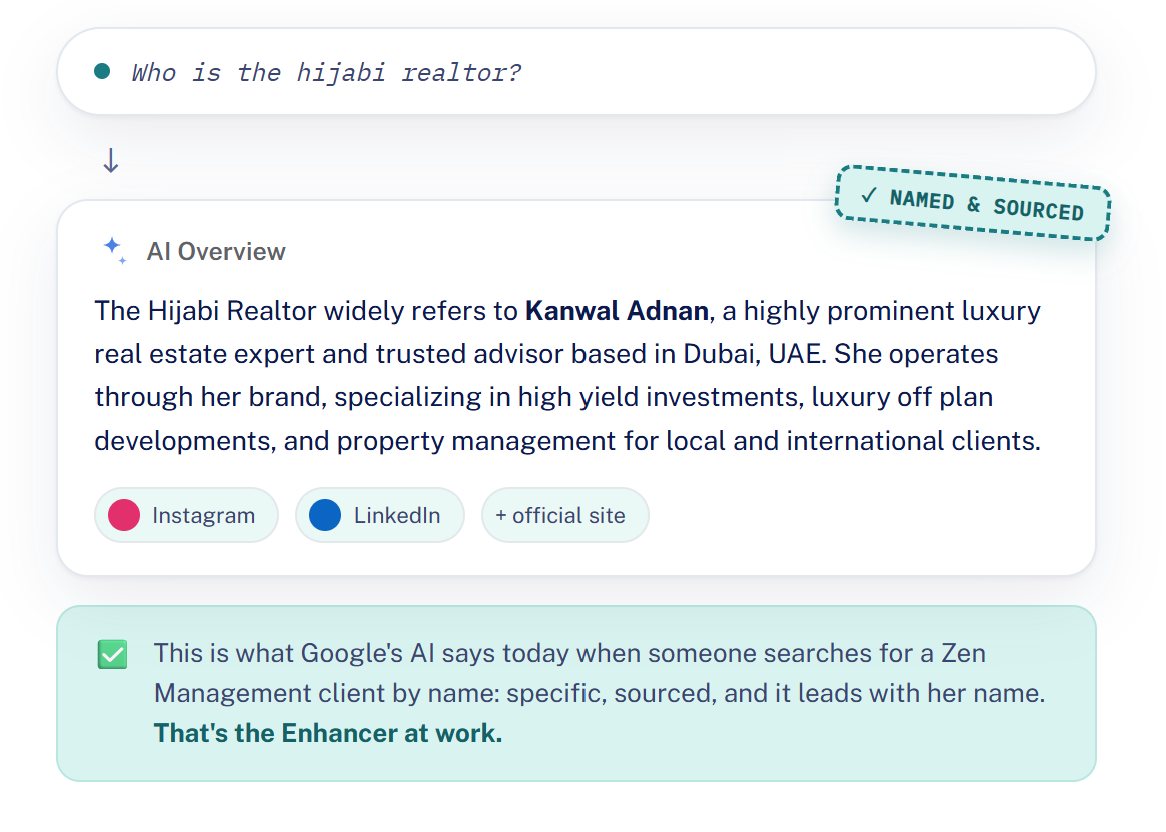
Here are the live results of a client who used the AiSO enhancer:
A Fall Offer for Zen Growth Playbook Readers
Don’t have time or resources to manage this on your own? Don’t stress.
This fall, we’re opening a limited number of VIP spots for my AI Search Optimization (AISO) Enhancer: built specifically to help GCC and US businesses show up when AI tools get asked about them.
It delivers:
A kickoff session mapping your priority search and AI visibility goals.
A full audit of where you stand today across Google, LinkedIn, and AI search.
Implementation of our semantic keyword framework, built for how AI actually indexes content, beyond basic SEO.
A 30-day benchmark report showing exactly what changed.
Readers of this newsletter can access it at the early adopter VIP rate of AED 15,000 ($4,000), down from AED 20,000 ($5,500) using the early adoptor code FALLVIP.
The businesses that get comfortable being invisible to AI right now are making the same mistake businesses made in 2005 when they decided a website was optional.
It wasn’t optional then. This isn’t optional now so let’s grow your visibility.
From my best to yours,
L.
Founder and Chief Strategist,
Zen Management®
About Zen Management®
Zen Management® helps founders and teams cut through the noise, optimize marketing and business systems, and accelerate growth with clarity.
From strategy and marketing to analytics, AI automation, and AiSO, we help businesses build smarter ways to attract, convert, and retain customers while reducing the work it takes to keep everything moving.
Whether you need a clearer growth strategy, better marketing performance, stronger visibility across AI search, or smarter systems that work behind the scenes, Zen Management® helps you turn complexity into a business that runs better.
Take away the stress of business. Partner with Zen Management®.